
Services
Bridges
We close the gap left by missing teeth with custom bridges, crafted with help from our on-site lab.

Why choose us
Benefits of Bridges
Fill The Gap
We replace one or more missing teeth so your smile looks complete again.
Chew And Speak Comfortably
A secure bridge restores your bite so eating and talking feel natural.
On-Site Dental Lab
Our in-house lab lets us craft and adjust your restoration right here.
Implant Options Available
We offer both traditional and implant-supported bridges depending on what fits your mouth best.
Insurance And Payment Plans
We accept all major PPO plans, self-pay patients, and offer flexible payment plans.
A missing tooth rarely stays a problem of just one tooth. The teeth on either side begin to tip toward the empty space, the tooth above or below starts to drift downward, and chewing shifts to the other side of the mouth. A dental bridge stops that chain reaction by filling the gap with a replacement tooth that is anchored to the natural teeth beside it — restoring the bite and the look of your smile in a fixed, non-removable way.
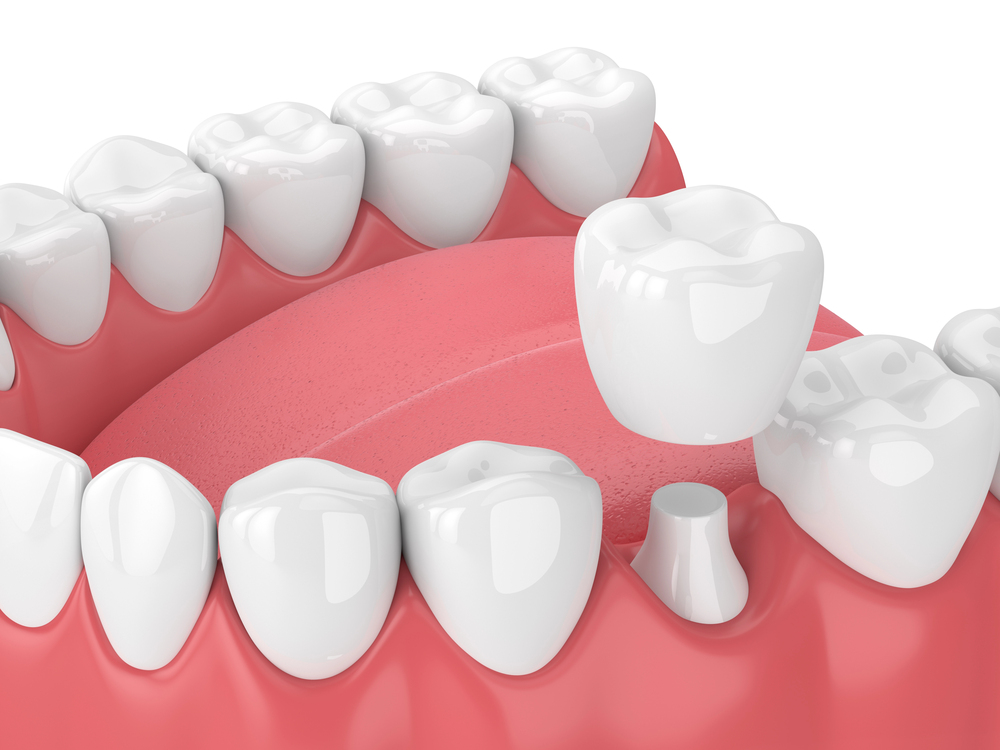
A traditional bridge is made of two or more connected crowns with one or more artificial teeth, called pontics, suspended between them. The crowns are cemented onto the healthy teeth bordering the gap, which are known as abutment teeth. Once placed, the bridge is held in position permanently, so you don't take it out at night or soak it the way you would a partial denture.
We also offer implant-supported bridges, which rest on dental implants instead of natural teeth. This option makes sense when several teeth in a row are missing, when the neighboring teeth are healthy and we'd rather not reshape them, or when there simply aren't teeth on both sides of the space to serve as anchors. Because we place dental implants here and also provide bone grafting and sinus lift surgery when the jaw needs additional support, we can map out the full plan in one place rather than sending you back and forth between offices.
The right choice depends on the gap itself, the strength of the surrounding teeth, your gum health, and your budget. We'll walk through the trade-offs with you honestly, including how a bridge compares with a single implant, a partial denture, or an implant-supported denture.
Good candidates generally have healthy teeth on either side of the gap and gums that are free of active disease. If gum disease is present, we treat it first — through scaling and root planing, periodontal maintenance, or more involved periodontal care — because a bridge cemented over unstable foundations won't hold up. Likewise, if an abutment tooth is cracked or deeply decayed, it may need a filling, root canal therapy, or crown lengthening before it can carry the load.
Bridges help in a wide range of everyday situations: a molar lost to a fracture years ago, a front tooth knocked out in an accident, a tooth extracted because decay went too far, or an old bridge that has loosened and needs replacement. We see patients of all ages for these concerns, and because we accept patients without a referral across our restorative and surgical services, you can start the conversation here without an extra step.
A few things worth knowing before you commit:
- A traditional bridge requires reshaping the two adjacent teeth so crowns can fit over them.
- Bridges are cleaned differently than natural teeth — floss threaders or a water flosser are used to clean beneath the pontic.
- An implant-supported bridge takes longer overall because implants need time to integrate with the bone.
- Nitrous oxide sedation and oral sedation are available if dental anxiety is a factor.
- Our on-site dental lab shortens lab turnaround and keeps adjustments in-house.
Caring For Your Bridge And What Results Look Like
Most people adjust to a new bridge within a few days. Speech normalizes quickly, and chewing on that side becomes comfortable again once the bite feels even. We check the bite carefully at placement and will gladly fine-tune it afterward — small adjustments are normal and easy to make.
Long-term success comes down to keeping the abutment teeth and gum tissue healthy. That means brushing twice daily, cleaning under the bridge every day, and keeping up with regular dental cleanings and exams with our hygienist. If you grind your teeth, a custom night guard protects the porcelain from unnecessary stress; if you play contact sports, we make sports mouth guards as well. We'll also screen the margins of the bridge at each visit, since decay at the edge of an abutment crown is the most common reason a bridge needs attention down the road.
Insurance, Payment, And Scheduling
We accept all major PPO insurance plans and file claims as a general practice, which simplifies paperwork across restorative, surgical, and periodontal treatment. We welcome self-pay and cash patients, and flexible payment plans are available so a larger restorative case can be spread out over time. Before treatment begins, we'll go over the estimate with you so there are no surprises.
Our team has cared for families in Ocala for more than 30 years, and we see patients from Belleview, Silver Springs, Summerfield, Dunnellon, Lady Lake, The Villages, Marion Oaks, and throughout Marion County. If you're living with a gap in your smile — or an older bridge that isn't working the way it used to — we'd be glad to take a look and talk through your options. Call Ocala Dental Care to schedule your consultation with Dr. Salifu or Dr. Geris.
The process
What to expect
- 1
Exam And Planning
We examine your teeth and gums, review your options, and map out a plan together.
- 2
Prepare And Place
We shape the supporting teeth or implants, take impressions, and fit your bridge.
- 3
Follow-Up Care
We check your bite, make any adjustments, and show you how to keep your bridge clean.