
Services
Dentures
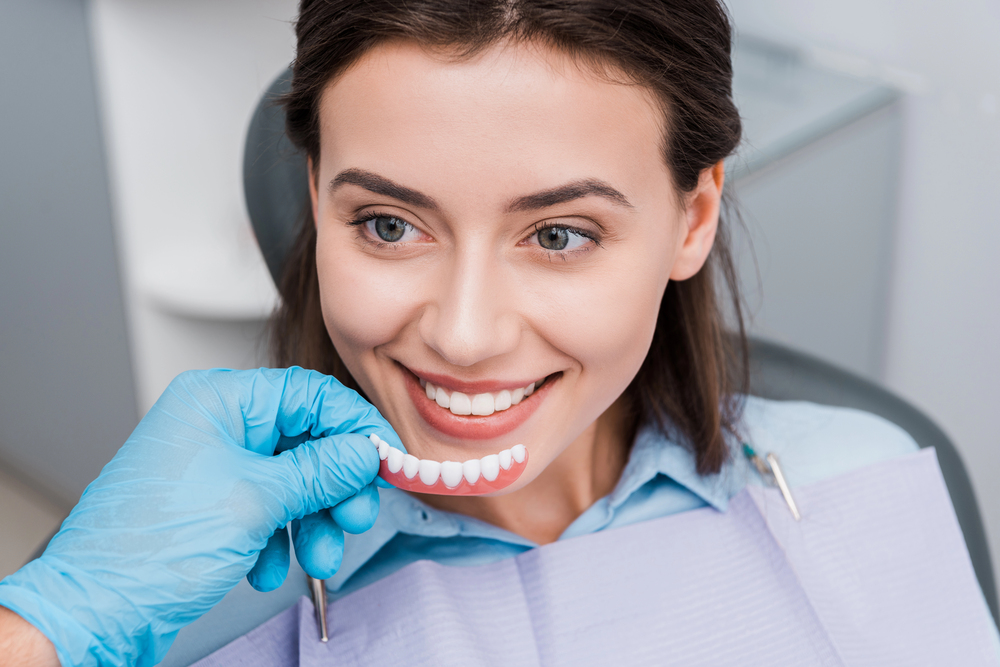
Complete dentures replace a full arch, partials fill gaps around your natural teeth — crafted in our on-site lab.

Why choose us
Benefits of Dentures
Complete Or Partial
Complete dentures replace a full arch, while partial dentures fill in gaps when you still have healthy natural teeth.
On-Site Dental Lab
Our in-house lab lets us craft and adjust dentures right here, often shortening your wait.
Fast Repairs And Relines
We repair or replace existing dentures, including ones made somewhere else.
Implant-Supported Options
If you want more stability, we also offer implant-supported and snap-in dentures.
Flexible Payment Options
We accept all major PPO plans, self-pay patients, and offer flexible payment plans.
Missing teeth change far more than a smile. They shift how you chew, how clearly you speak, how your cheeks and lips are supported, and how comfortable you feel in a conversation. Dentures remain one of the most practical, time-tested answers to that problem, and because we keep a dental lab on site here in Ocala, we can design, adjust, and repair them without sending your case across the state and waiting weeks for a reply.
A complete denture replaces all of the teeth in an arch — upper, lower, or both. It rests on the gum tissue and the underlying bone, and it's the right fit when the remaining teeth can no longer be saved, or when an arch is already fully edentulous. Patients often come to us after years of patching individual teeth, finally ready for a stable, uniform result rather than another repair.
A partial denture is for mouths where healthy natural teeth remain. It fills the gaps with replacement teeth set into a framework that clasps onto or rests against the natural teeth, keeping them from drifting into the open spaces. If you're missing a few teeth on one side, or scattered teeth across an arch, a partial preserves what you still have while restoring chewing surfaces. The simplest way to compare the two: a complete denture replaces an arch, a partial completes one. Which you need depends on how many teeth remain, the health of those teeth, and the condition of your gums and bone — all of which we evaluate before recommending anything.
Different situations bring people to denture care, and each one shapes the plan. Some patients need extractions first, in which case we discuss healing time and how a denture will fit a ridge that is still settling. Some arrive with an older denture that has become loose as the jawbone changed shape over the years — a normal process, and one that calls for adjustment, relining, or replacement rather than simply living with the discomfort. Others bring in a cracked or broken appliance and need it back the same day, which our on-site lab makes possible for many repairs.
We also talk openly about implant-supported dentures and snap-in options for patients who want more stability than a conventional denture provides. Implants placed in the jaw give a denture something firm to anchor to, which can help with lower dentures in particular. That isn't the right or necessary choice for everyone, and conventional complete and partial dentures continue to serve many patients very well. Because we provide extractions, implants, bone grafting, and prosthetics under one roof, you can weigh these paths with us in a single conversation instead of being referred around town.
Living With Your Dentures
New dentures take practice. Most people notice increased saliva at first, some awareness of bulk, and a short adjustment period with speech — reading aloud at home speeds that along considerably. Start with softer foods cut small, chew on both sides at once to keep the denture balanced, and work back toward your usual diet as your confidence grows.
Day-to-day care is straightforward but non-negotiable:
- Remove and rinse your denture after meals to clear trapped food
- Brush it daily with a soft brush and a non-abrasive cleaner, never regular toothpaste
- Clean your gums, tongue, and any remaining natural teeth every day
- Store the denture in water or a soaking solution overnight so it doesn't dry out and warp
- Handle it over a folded towel or a basin of water to protect against drops
- Keep your regular exams so we can check fit, tissue health, and your remaining teeth
Gums and bone continue to change over time, so a denture that fit beautifully two years ago may need a reline. Sore spots in the first weeks are common and usually resolved with a small adjustment — please call rather than filing it down yourself or relying on over-the-counter adhesive to mask a fit problem.
Cost, Insurance, and Getting Started
We accept all major PPO insurance plans and file claims as a general practice, and we're glad to help you understand what your plan covers before treatment begins. Self-pay and cash patients are welcome, and flexible payment plans are available so the cost can be spread out sensibly.
Our team — Dr. Hussein Salifu and Dr. Marco Geris — has cared for families across Ocala, Belleview, Silver Springs, Summerfield, The Villages, Dunnellon, and the surrounding Marion County communities for over 30 years. No referral is needed. Call us to schedule a consultation, and we'll look at your mouth, listen to what's bothering you, and lay out your options clearly.
The process
What to expect
- 1
Consultation And Exam
We examine your teeth, gums, and bite, then talk through whether complete or partial dentures fit your situation.
- 2
Fitting And Fabrication
We take impressions and work with our on-site lab to shape dentures that fit comfortably and look natural.
- 3
Adjustments And Care
We check your fit, make any adjustments, and stay available for future relines or repairs.